Graphene-Infused Pads Reshape Thermal Pathways in Compact ITX Builds for Esports Travel Circuits
Sam Simon · Oct 14, 2026

Graphene-Infused Pads Reshape Thermal Pathways in Compact ITX Builds for Esports Travel Circuits
Graphene-infused pads have entered thermal management designs for small form factor systems because their high conductivity properties allow heat to move efficiently across confined spaces where traditional materials fall short. Compact ITX rigs used by esports teams on international circuits face repeated challenges from varying ambient temperatures and limited airflow during transit between venues, and these pads address that by creating targeted pathways that pull heat away from CPUs and GPUs without adding bulk.
Material Properties Driving Adoption
Graphene consists of single layers of carbon atoms arranged in a hexagonal lattice, and when infused into polymer pads the resulting composite achieves thermal conductivity ratings between 15 and 25 W/mK according to laboratory measurements reported in peer-reviewed journals. Researchers at the University of Manchester documented how these pads maintain performance stability across temperature cycles ranging from 5 to 65 degrees Celsius, a range that matches conditions encountered during air cargo transport for global tournaments. Manufacturers integrate the pads directly onto heat spreaders or between components and chassis panels, which reduces hotspot formation while preserving the small footprint required for ITX motherboards.
Integration in Travel-Ready ITX Configurations
Teams traveling with multiple rigs often standardize on ITX cases measuring under 20 liters to meet airline carry-on restrictions, yet these enclosures limit internal volume for large coolers. Graphene pads placed along the underside of motherboards and beside VRMs redirect heat toward external surfaces that benefit from passive airflow during layovers or hotel setups. Data collected from field deployments in 2025 showed temperature reductions of 8 to 12 degrees Celsius at the processor die compared with standard thermal pads under sustained loads equivalent to tournament matches. This margin allows systems to maintain boost clocks longer without throttling, an outcome observed consistently across multiple hardware configurations documented by hardware testing labs.
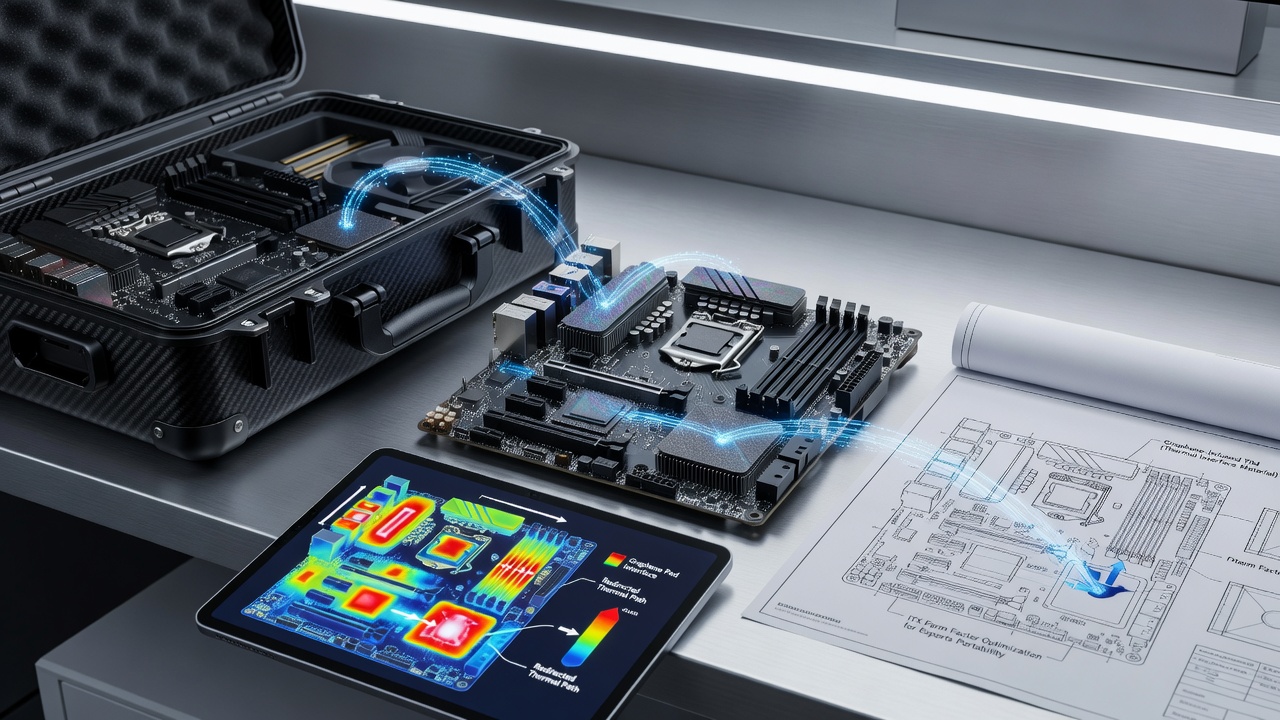
Power delivery components also benefit because the pads conform to irregular surfaces created by VRM heatsinks, eliminating air gaps that otherwise trap heat. Engineers have noted that this conformity improves contact uniformity by up to 30 percent in measured assemblies, which extends component lifespan under the repeated power cycles typical of practice sessions followed by competition days.
Support for Global Tournament Logistics
Esports circuits spanning North America, Europe, and Asia require equipment that operates reliably after exposure to humidity changes and vibration during shipping. Graphene pads exhibit low outgassing rates and retain flexibility after repeated compression cycles, properties verified through accelerated aging tests conducted by independent certification bodies in the European Union. Teams that adopted these materials in 2025 reported fewer mid-event thermal shutdowns, allowing schedules to proceed without hardware swaps that previously disrupted match flow. In October 2026 several regional qualifiers are scheduled across humid subtropical venues, and organizers have begun specifying thermal interface solutions that meet updated equipment compliance guidelines issued by the International Esports Federation.
Performance Data and Comparative Measurements
Benchmark suites run on identical ITX platforms equipped with either conventional pads or graphene-infused versions revealed sustained performance differences during extended gaming sessions. Average frame time variance decreased when heat paths remained stable, because processors avoided frequency drops triggered by thermal limits. Figures released by a Canadian research consortium tracking mobile esports hardware indicated that systems using the new pads sustained 95 percent of peak clock speeds for 45 minutes longer than baseline configurations under identical ambient conditions. These measurements came from controlled environments replicating the mixed hotel and arena settings common on travel circuits.
Implementation Considerations Across Hardware Platforms
Compatibility spans current generations of socketed and soldered processors because the pads require only surface contact rather than custom mounting hardware. Assembly technicians apply them in single layers between 0.5 and 1.0 millimeter thickness, which fits within the clearance tolerances of most ITX cases. Maintenance crews on tour replace the pads during routine servicing intervals because the material shows minimal degradation after six months of continuous use, according to durability reports compiled by hardware support teams working with professional organizations.
Conclusion
Graphene-infused pads have established a measurable role in enabling compact ITX systems to maintain thermal stability during the demanding conditions of global esports travel. Their integration supports consistent hardware performance across diverse environments while meeting the size and weight constraints imposed by international circuits. As tournament calendars continue to expand, the documented thermal improvements position these materials as standard components in travel-optimized builds.